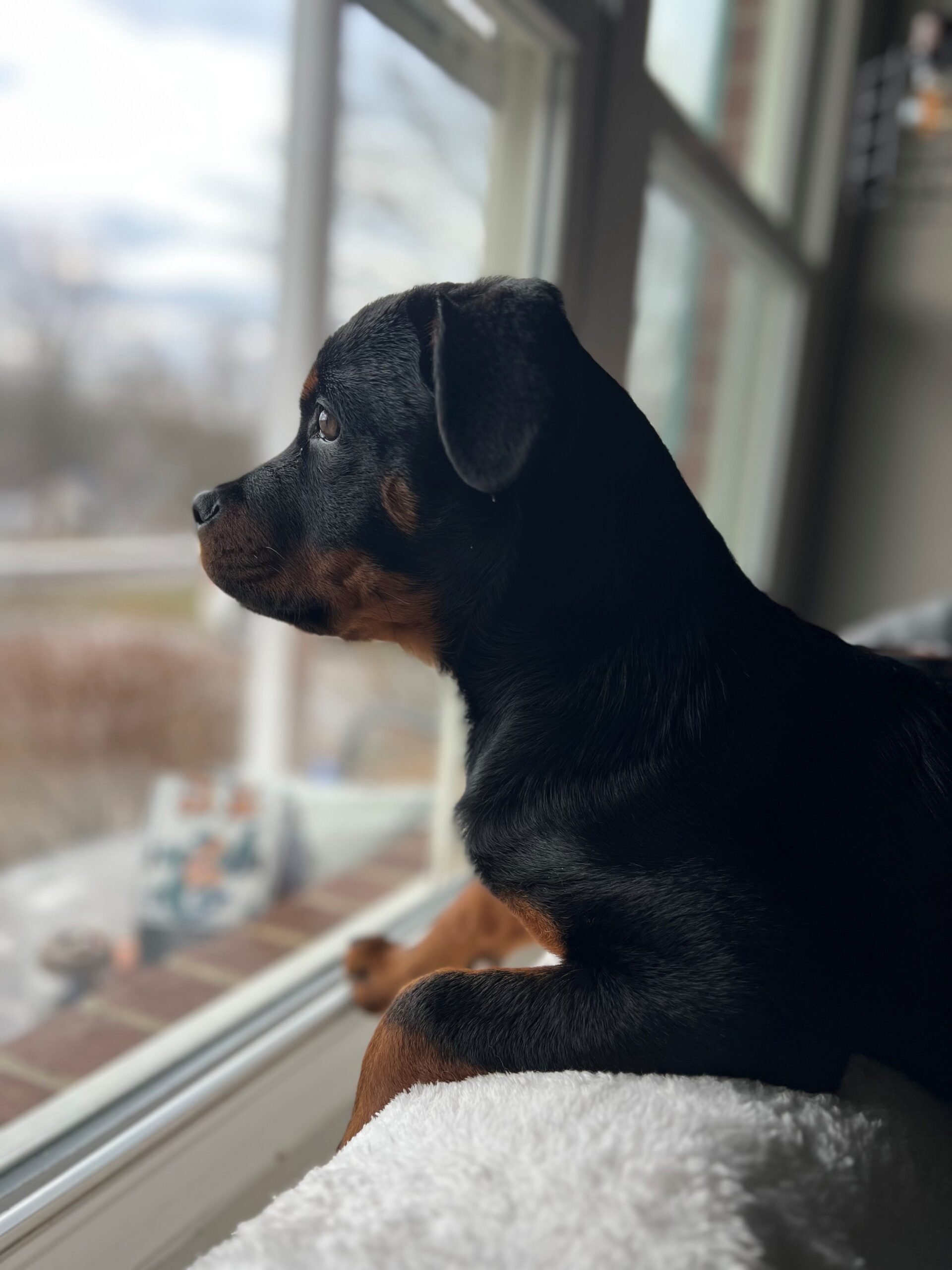
Willow and I recently took our first major trip together to Tybee Island, GA—a place full of sand, salt air, and unexpected lessons. We spent our days walking, exploring, and putting important life skills into practice. Some moments were effortless, others asked more of us… but each one shaped us.
And here’s the twist: the biggest learner on this trip might not be who you expect.
Read on to discover what our journey taught us.
Overall, Willow did an impressive job navigating all the new sights, sounds, and surprises of a completely unfamiliar environment. She learned to stay connected and focused, even amid constant stimulation. She began checking in with me whenever she wasn’t sure how to interpret something new, and she discovered one of the most important travel skills of all: how to rest when you can.
On the flip side, Willow also learned a harder lesson—people sometimes have negative associations with Rottweilers. Even though she wants to say hello, not everyone is comfortable reciprocating. It was a valuable reminder about managing expectations and respecting others while out in the world.
I, on the other hand, may have learned the most—not just about Willow, but about the behaviors we still need to refine and the role I play as her partner. This trip reminded me how much my guidance, timing, and support shape our success on every adventure we take together.
- Make a plan. I’ve never been great at planning, especially on vacation—I tend to just get out and start moving. That works fine when it’s just me, but with a young, adolescent dog, planning is essential. On this trip, I ventured too far from our vacation house, leaving Willow with a full cup of stimulation and no real way to decompress.
In an environment with so many new sights, sounds, and smells, I should have driven to a spot where we could still enjoy the surroundings while giving her the option to rest in the car. Instead, we ended up on a five-mile walk with almost no downtime. Knowing this, I had to adjust my expectations on the walk back, choosing quieter paths to help reduce reactivity and give her brain a chance to settle.
- Require more downtime. At home, when Willow needs to rest, I place her in her spa room with her noise machine and fan. She knows it’s nap time, and I feel she gets the rest she needs.
On this trip, however, the crate I brought wasn’t one she enjoys, and she had no interest in using it. Being in a new environment, without one of her siblings, she was understandably nervous about being left alone. At one point, I tried setting up the bedroom to mimic her usual environment as much as possible, keeping my “go” bag within her sight so she knew I was still nearby. At home, she uses the bag as a signal for whether I’m present or not.
I do feel she learned an important lesson: how to rest outside her crate. Moving forward, we’ll continue building on this skill at home rather than defaulting to the spa room. This is something I recommend for any dog as they begin to mature.
- Walking skills in tighter spaces. At home, our walks usually take place in open areas where Willow has plenty of room, often using a long leash of 15–30 feet. On vacation, we faced much tighter spaces, like sidewalks where she needed to pass people and other dogs.
Although we’ve started practicing closer walks at home, we hadn’t yet mastered them enough to make these sidewalk walks seamless. Instead, we relied on curves and occasionally stepped aside to let distractions pass. While I could have used the “magnet” technique—holding a treat near her nose to guide her past distractions—she was so overstimulated that this likely wouldn’t have been as effective.
Using curves, however, provided extra distance, communicated calmness, and kept everyone safe—an important reminder that patience and thoughtful adjustments often trump pushing for perfection. Moving forward, we’ll continue practicing close-quarter walking in quieter environments and for shorter periods, gradually building her confidence and focus.
- Working with distractions. Willow hasn’t experienced nearly as many distractions as she encountered on our trip. At home, she might see a bicycle or two, a walker, a walker with a dog, or even a cat in the road—but rarely all at once.
Being exposed to so many stimuli at the same time was a new challenge for her, and it highlighted a skill we need to continue developing: learning to stay calm, focused, and connected, even when multiple distractions occur simultaneously.
The best way to practice handling distractions is to start in a calm, controlled setting. Sitting and observing the world allows Willow to process what’s happening around her, rather than constantly anticipating what might come next, as she often does on a walk.
We spent some time just hanging out and watching the world go by, but even then, the area was full of people, dogs, balls, scooters, cars, and music. It’s important to ensure your dog’s “cup” isn’t already full before attempting this, and to choose locations where you have a higher level of control. This helps create a safer, more productive learning environment.
Luckily, we were able to park nearby, so the car was just a short walk away—providing a convenient spot for decompression whenever Willow needed it.
The skills I’ve taught Willow truly paid off on this trip. Our walking cues gave her the freedom to safely explore off-leash around the unfenced vacation home and during portions of our walks when it was appropriate. I also consistently used the Mr. Rogers hack—naming what we saw and calmly explaining the world around us. Each time we approached something new or potentially overwhelming, she looked to me for information and guidance. That trust kept her reactivity to a minimum; the only moments she struggled came near the end of our five-mile walk, when her cup was full and multiple distractions stacked on top of each other.
She was also more vocal in the car, a clear sign of overstimulation and reduced rest. But despite all of that, her connection to me remained strong. She checked in frequently, stayed close, and rarely needed a recall cue. This trip was a reminder that training is not just about obedience—it’s about building a relationship rooted in trust, communication, and mutual understanding.
Our trip to Tybee Island was more than a vacation—it was a masterclass in patience, observation, and growth for both Willow and me. Every challenge, every distraction, and every quiet moment of rest taught us something new about each other and about the skills we still need to refine. Traveling with a dog isn’t just about seeing new places; it’s about creating opportunities to practice life skills, strengthen your partnership, and learn how to navigate the world together. Willow came away more confident, more connected, and more adaptable—and I came away with a deeper understanding of how to guide her with patience, structure, and care. We returned home not just with memories of sand and sea, but with a roadmap for continued learning and growth on every adventure ahead.